Corporate Live Streaming Has Come a Long Way
Corporate live streaming has moved far past the webinar. Here is how broadcast production and real audience interaction make remote attendees part of the show.
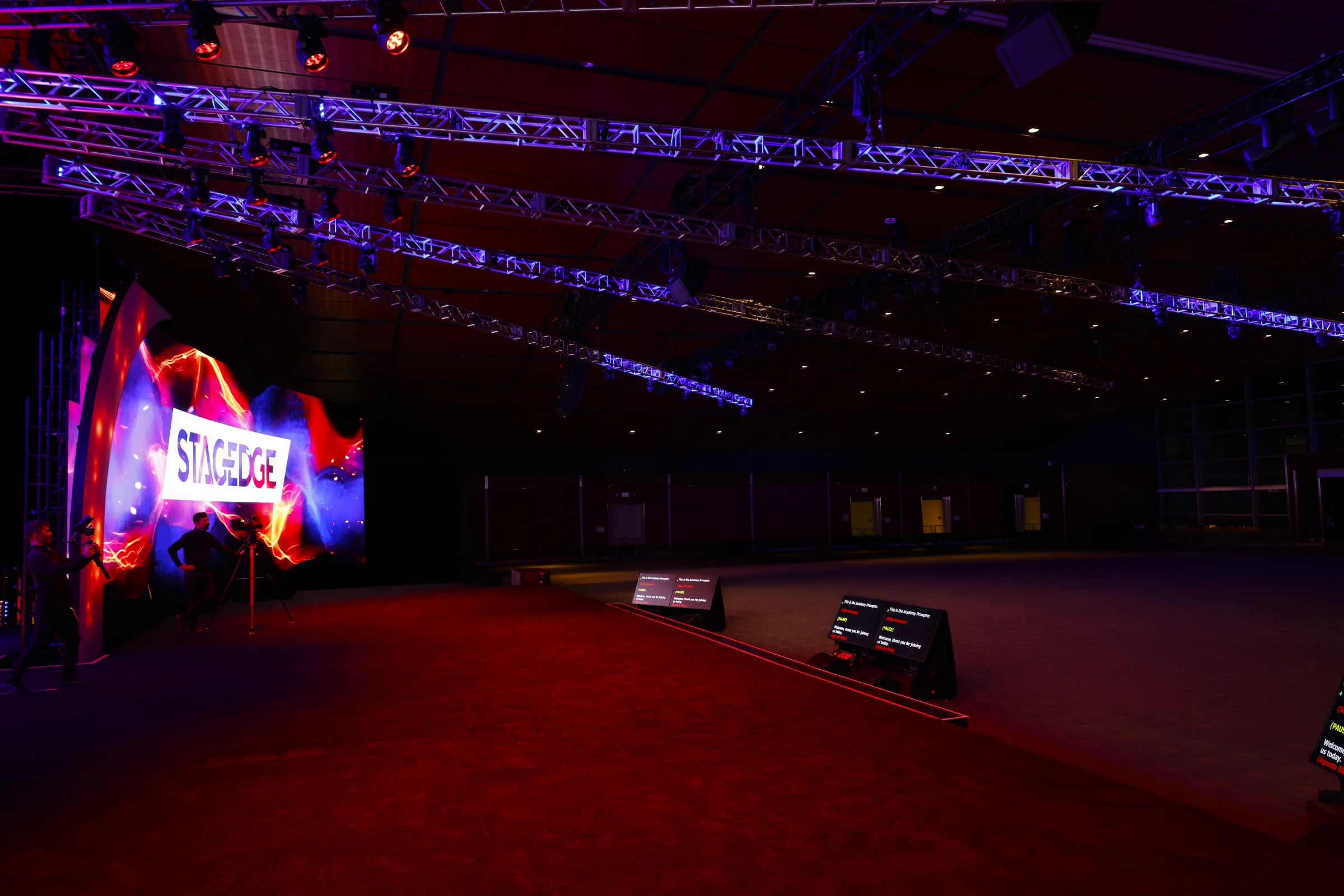
When you think about a virtual event, what comes to mind? A webinar? A grid of faces on a screen? Maybe a presentation with a chat box running alongside it?
There’s nothing inherently wrong with any of those things. But if that’s where your expectations for corporate live streaming begin and end, there’s a lot more to explore.
Today, we can bring together presenters in different cities, create custom broadcast environments, produce content that looks and feels like live television, and give remote audiences a genuine role in the program. Virtual and hybrid events have become much more than a convenient alternative to getting everyone in the same room.
At Stagedge, we call our approach Interactive Streaming. It brings together live event production, broadcast technology, creative design, and audience engagement to create experiences that work wherever people are watching.
There’s a Person on the Other Side of That Screen
When you’re producing an event with both in-person and remote attendees, it’s easy to focus on what’s happening in the room. That’s where the speakers are, where the stage is, and where you can see how the audience is responding.
But for a global town hall or company-wide meeting, the people watching online might outnumber the people in the room by thousands. They may be joining from offices, conference rooms, or their kitchen tables halfway around the world. And they all deserve an experience that feels like it was designed with them in mind.
That means thinking about more than whether the camera feed is working. Can remote attendees follow the conversation? Can they ask questions? Will their input reach the people on stage? Can they participate in ways that make sense for the program?
These are the kinds of questions we like to work through with clients early in the planning process. Because the difference between watching an event and being part of one often comes down to decisions made long before show day.
Sometimes the Right Call Is to Hold the Show
Stagedge’s Mike Basteri shared a story on the first episode of our EdgeWork podcast that gets right to the heart of this.
It was the beginning of COVID, and his team was in Salt Lake City producing an event that had originally been planned as an in-person gathering. The event had moved online, with thousands of attendees expected to watch remotely. About 15 minutes before going live, they discovered a technical problem affecting the stream.
The team had a schedule to keep, and everyone was prepared to start. But there was one pretty significant issue: the audience wasn’t going to be able to see the event.
As Mike recalled, the pressure was to go ahead as planned. But his response was straightforward: “I appreciate staying on schedule, but there’s nobody in room, so we have to wait.”
The team held the show while they tracked down and resolved the problem, ultimately starting about 10 to 15 minutes late. It wasn’t an easy call in the moment, but it was the right one.
“It ended up being the best decision,” Mike said, explaining that the experience helped establish a lasting partnership and trust with the client.
There’s a lot in that story about technical troubleshooting, communication, and making decisions under pressure. But there’s also an important lesson about the audience. For years, event production teams had prioritized the people physically sitting in the room. Now, the people watching online were the entire audience, and that changed how the team needed to think about the show.
As EdgeWork host and Stagedge Executive Producer Andrew Nugent put it during the conversation, “We’re going to make it as good as possible for as many people as we possibly can.”
We think that’s a pretty good way to approach any event, regardless of where the audience is watching.
Think Beyond the Webcam
Let’s get into what’s possible when you treat a corporate live stream like a broadcast production.
We’re talking about many of the same creative and technical tools used in television, sports, and entertainment broadcasting. Multiple camera angles, professional audio, live graphics, custom scenic environments, pre-produced video, dedicated show direction, and remote presenters joining from different locations can all come together to create one cohesive program.
A company-wide meeting can feel like a professionally produced leadership broadcast. A panel discussion can bring together speakers in three different cities. A product launch can combine live presentations, demonstrations, and produced video segments without needing the entire team to be in one location.
Of course, not every program needs all of that. Sometimes a simple, well-produced broadcast is exactly what the event calls for. The important thing is understanding the options and choosing the ones that support what you’re trying to accomplish.
Interaction Doesn’t Happen by Accident
Adding a chat box to a live stream doesn’t automatically make it interactive. Neither does putting a polling question on screen. Those tools can be useful, but only when there’s a plan for how they’re going to be used.
Take live Q&A, for example. For an event with in-person and remote attendees, we can use platforms like Slido or Pigeonhole to bring questions from both audiences into one place. But somebody needs to manage those questions, make sure the presenter knows what’s coming, and build enough time into the run of show for the conversation to happen.
The same goes for polling, virtual networking, and breakout sessions. A live poll can give a presenter immediate insight into what the audience is thinking and help steer a discussion. Virtual networking spaces and AI-supported matchmaking can help people connect across locations. A dedicated virtual MC can give remote viewers someone speaking directly to them.
When you’re reaching a global audience, live captioning and translation can also help remove barriers to participation, giving people more ways to follow along and engage with the content.
There’s a lot we can do, but the question we always come back to is: What do we want people to get out of this?
If the goal is for employees to hear directly from leadership, maybe the most valuable interaction is a well-managed Q&A. If the goal is to build relationships across an organization, networking and smaller group conversations might deserve more attention. And if the event is primarily about sharing critical information, a clear, reliable, accessible broadcast might be the most important thing.
The People on Camera Need a Plan, Too
Speaking to a camera is different from standing in front of a room full of people. In person, speakers can see facial expressions, read the room, and adjust their delivery based on how the audience responds. On camera, much of that feedback disappears.
That’s why we work with presenters to help them get comfortable with the production environment. Sometimes it’s as simple as remembering to look into the lens when speaking to remote viewers. Other times, it means rehearsing how questions will come in from different locations, how they’ll respond to live polling, or how a conversation will move between presenters.
When multiple locations, speakers, and interactive elements are involved, those details matter even more. Everyone needs to understand the cues, the transitions, and what’s expected of them before the program goes live.
The more comfortable presenters are with the process, the more naturally they can connect with the audience. And when that happens, the technology starts to fade into the background, which is exactly where it belongs.
One Show Doesn’t Have to Mean One Location
You don’t necessarily need to bring everyone together in the same building to produce one cohesive experience.
Sometimes the best solution is to build a broadcast studio on location. For an event with an in-person audience, that allows us to serve the room and the remote viewers at the same time, coordinating lighting, audio, cameras, scenic elements, and broadcast production around the program.
Other times, our studio in Tewksbury, Massachusetts, is a better fit. With a 25-by-25-foot cyc wall, green-screen capabilities, a dedicated control room, and an experienced crew on site, we can produce everything from executive announcements and town halls to panel discussions and branded broadcasts.
And sometimes the answer is a combination.
At a recent program with a venture capital firm, we worked from the Stagedge studio in Massachusetts while a remote camera crew captured presenters in San Francisco. Two locations, thousands of miles apart, contributing to one coordinated broadcast.
There’s still plenty of coordination involved, of course. Camera feeds, audio, graphics, cues, timing, connectivity, and backup plans all need to work together. But that’s the work we do every day, and we know how to make those moving parts work as one.
Let’s Talk About Budgets
One of the practical advantages of virtual and hybrid events is that they can make it possible to reach more people without paying to bring everyone to the same location. When you’re talking about a global organization, that can make a substantial difference.
But there’s a balance to strike. Saving money on flights and hotel rooms doesn’t do much good if the audience has trouble hearing the presentation or the stream cuts out halfway through.
We generally recommend protecting the parts of the production that keep the experience reliable: audio, connectivity, backup systems, show direction, and the crew responsible for making it all work. Beyond that, there’s room to get creative.
Maybe the event doesn’t need a large scenic build. Maybe some content would be better produced in advance. Maybe the Stagedge studio makes more sense than transforming a separate venue into a broadcast space.
We’ve been doing this work long enough to know that more equipment doesn’t automatically mean a better event. It’s about using the right equipment, the right people, and the right production approach for the job.
There’s also another opportunity worth considering: what happens to the content after the event?
A leadership broadcast can become an on-demand resource for employees. A conference panel can be edited into shorter videos. A product demonstration can be repurposed for future communications. With the right planning, one live event can produce content that continues working long after the cameras are off.
Attendance and engagement reporting can also give organizations a better understanding of who participated, what resonated, and how to make the next experience even stronger.
We’ve Done a Few of These
Interactive Streaming builds on work Stagedge has been doing for years. We’ve helped organizations produce virtual meetings, hybrid conferences, global broadcasts, and live programs with some pretty complicated moving parts.
For Thermo Fisher Scientific, we supported a global town hall reaching more than 20,000 simultaneous viewers. For Dynatrace, we produced a virtual investor day with live Q&A following the company’s IPO. And for bioMérieux, we helped bring its first virtual sales meeting to life in just 58 working days.
Every event is different, but the approach stays the same. Understand what needs to happen, build around the audience, and prepare for what might change. The technology and the way people attend events will keep evolving, but the experience it takes to bring a production together is something we’ve built over years of doing the work.
So, What Are You Trying to Make Happen?
Maybe you’re planning a global town hall and need to reach employees across a dozen offices. Maybe you’ve got speakers in different countries and want to bring them together for one live program. Or maybe you’ve been producing the same virtual meeting for years and know there’s an opportunity to do something more with it.
There’s no single right way to produce these events, and that’s part of what makes the work interesting.
At Stagedge, we bring more than 50 years of event production experience together with broadcast technology, creative thinking, and a team that knows how to handle the moving parts. From boardrooms to ballrooms, our studio to yours, we’ve seen just how much is possible when the right people and ideas come together.
Tell us what you’re working on. We’ll help figure out how to make it happen.
Frequently Asked Questions About Corporate Live Streaming
What is corporate live streaming?
Corporate live streaming is the real-time broadcast of an organization’s events, meetings, or presentations to an online audience. Common uses include company-wide town halls, executive announcements, investor presentations, sales meetings, product launches, and conferences. Professional corporate live streaming can include multiple cameras, custom graphics, broadcast audio, and interactive audience features.
What is Interactive Streaming?
Interactive Streaming is Stagedge’s approach to producing virtual and hybrid event experiences using broadcast-quality production, creative design, and meaningful audience participation. It combines professional live streaming technology with features like live Q&A, polling, virtual networking, and multi-location production to create experiences that engage remote audiences.
How is Interactive Streaming different from a virtual or hybrid event?
Virtual and hybrid describe how people attend an event. Interactive Streaming emphasizes how the event is produced and experienced. It uses professional broadcast production, audience engagement tools, and creative design to make the experience more cohesive for remote and in-person audiences. Interactive Streaming can be used for both fully virtual and hybrid events.
What types of corporate events can be live streamed?
Corporate live streaming can support global town halls, leadership broadcasts, employee meetings, investor days, sales kickoffs, product launches, conferences, training programs, and other internal or external communications. The production approach depends on the size of the audience, the event’s objectives, and how attendees need to participate.
How can remote attendees participate in a hybrid event?
Remote attendees can participate through live Q&A, audience polling, chat, virtual networking lounges, breakout sessions, and other engagement tools. A dedicated virtual MC can also help facilitate participation and bring remote audience questions into the live program. These features work best when they’re planned into the event from the beginning.
Do we need a studio to produce a professional corporate live stream?
No. Professional live streaming can be produced from an existing event venue, a corporate office, a dedicated broadcast studio, or multiple connected locations. Stagedge can build an on-location broadcast environment, produce from its studio in Tewksbury, Massachusetts, or coordinate remote production crews depending on the event’s needs.
Can a corporate live stream include presenters from multiple cities?
Yes. Multi-location live streaming allows presenters in different cities or countries to participate in one coordinated broadcast. Remote camera crews, professional audio and video systems, and centralized production direction can help create a cohesive experience without requiring all presenters to travel to one location.
How much does professional corporate live streaming cost?
The cost of corporate live streaming depends on several factors, including the number of presenters and locations, production complexity, equipment requirements, audience size, and interactive features. An experienced production partner can help identify the right setup and balance production quality with the available budget.
What equipment is needed for corporate live streaming?
Professional corporate live streaming typically involves cameras, microphones, audio mixing, video switching, lighting, streaming encoders, internet connectivity, and production monitoring. Depending on the event, additional equipment may include custom scenic elements, graphics systems, backup connections, and remote contribution technology.
Can corporate live streaming support international audiences?
Yes. Corporate live streaming can connect presenters and audiences across multiple countries and time zones. Depending on the program and platform, live captioning, translation, and accessibility features can help organizations reach multilingual and geographically distributed audiences.
Can live-streamed event content be used after the event?
Yes. Corporate live streams can be recorded and repurposed into on-demand videos, training resources, internal communications, social media clips, and other content. Planning for content reuse before the event can help organizations get additional value from their production investment.
Where does Stagedge provide corporate live streaming services?
Stagedge is a Boston-area event production and creative partner with a dedicated production studio in Tewksbury, Massachusetts. The team supports corporate live streaming, virtual and hybrid events, and multi-location broadcasts for organizations across the United States and around the world.