Taking bioMerieux's Annual Sales Meeting Hybrid (Part 2)
How bioMerieux's hybrid annual sales meeting executed live, what worked for both audiences, and what it proved about the format.
Part 1 covered the planning decisions behind bioMerieux’s move to a hybrid annual sales meeting. This part looks at how it ran live, what held both audiences together, and what the format proved for future events.
How did the hybrid event execute live?
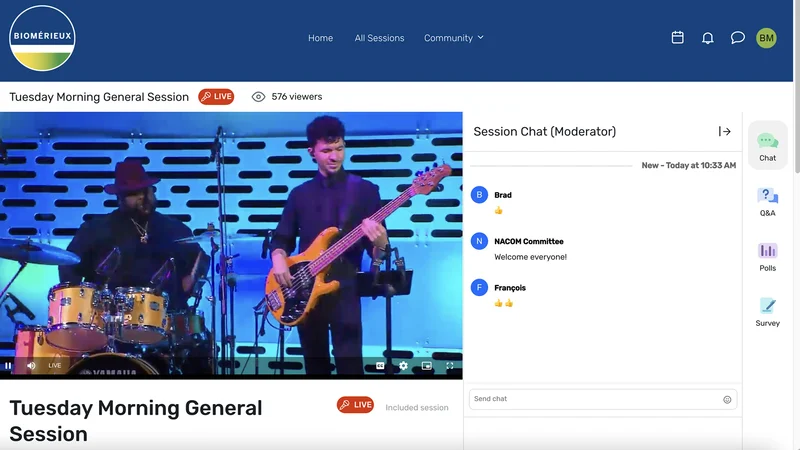
The event ran as two coordinated experiences rather than one broadcast to a split audience. In the room, the meeting kept the pace and energy of a live gathering. On screen, remote colleagues got a produced broadcast with clear audio, multiple camera angles, and a host who spoke to them directly rather than treating them as onlookers.
The production team managed both sides from a single operation, which kept the content, timing, and branding aligned. When the agenda moved, both audiences moved with it. When interaction happened, it was built to include the room and the remote audience at the same moment rather than pausing one to serve the other.
What kept the remote audience engaged throughout?
Three things carried the remote experience: pacing, direct inclusion, and production quality.
The agenda was tightened for attention spans and built around breaks that worked across time zones. Presenters addressed the remote audience by name and brought them into the discussion, so watching never felt passive. And the broadcast itself was produced to a standard that respected the remote viewer’s time, with the kind of switching and camera work that keeps a screen worth watching.
What did the hybrid format prove for bioMerieux?
It proved that a global sales organization could be aligned without requiring everyone in one room, and that a remote audience could be a full participant rather than a compromise. The meeting kept its core value (strategy alignment, connection, momentum for the year) while reaching colleagues who would otherwise have missed it entirely.
Just as important, it showed that hybrid done deliberately is not a downgrade from in-person. When the remote audience is designed for rather than accommodated, the format extends the reach of the event without diluting it.
What are the takeaways for other organizations considering hybrid?
Treat the remote audience as a first-class group from the first planning conversation. Tighten the agenda for attention and time zones. Build interaction that includes both audiences at once. Use one production team across both sides so nothing falls between the in-person and broadcast experiences. And invest in the broadcast quality that makes remote attendance worth the viewer’s time.
Done well, hybrid is not a fallback. It is a way to make a high-stakes meeting reach further while keeping everything that made it matter in the first place.